Monday, January 18, 2010

The Ultimate Face-to-Face Meeting


This weekend I had the pleasure of being an SOB. No, not that kind of SOB. Not even Liz Strauss’s Successful and Outstanding Blogger” SOB. Instead, I’m talking about being the Sister Of the Bride. My younger sister, Deborah, got married in Charleston, South Carolina, and it was amazing. She was beautiful, her new husband Dan is a great guy, and the entire family was there.

It occurred to me that a wedding is the end-all-be-all face-to-face meeting.
It sounds crazy, but in this world of virtual meetings, and live streaming, there are a million ways to “be there” without really being there. And it will never be the same.

Can you imagine the concept of a “virtual wedding”? I mean, really, would it ever be the same if the bride and groom were both on ichat when they said “I DO”? The very thought seems absurd. Instead, they stand face-to-face, hand-in-hand, and promise to love each other in sickness and in health, until death does them part.

There will be hundreds of pictures, an amazing video (thanks to my talented biz partner at CNTV!), and stories to tell, but they will never replace the experience for the bride and groom of being face-to-face. The pictures and videos also won’t replace the experience for those of us who watched it happen.

Being there meant that I heard the quiver in my sister’s voice when she said her vows. I watched as my Grandmother met her newest great-granddaughter for the first time. I felt my eyes well up as I watched my father dance with my sister.

While there are dozens of ways to share that moment, you can’t truly experience it without being there in person. The same is true for meetings of all kinds. We can tweet, post videos on Facebook, even create virtual meetings, and there is value to all of that.

But those things will never replace the face-to-face meeting, and the relationships that are formed when two people interact in real life. The next time someone asks me if I value the face-to-face meeting, I will answer with a resounding: I DO.

Tuesday, January 12, 2010

The debut of PCMA-TV


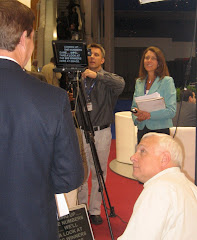
I haven't had much time to blog this week because I'm covering the Professional Convention Management Association in Dallas, Texas.

What an amazing conference! Our company, Convention News Television, has the privilege of producing video coverage we're branding "PCMA-TV".

The videos are running in the hotels, on monitors at the convention center, on www.PCMA2010.org and they're being emailed to the members.

We've met dozens of leaders in the meetings and travel industry, who are collaborating to change the image of their industry. I thought you might enjoy seeing the highlights... and I'll be sure to blog all the lessons I've learned when the conference is over.

In the meantime, LIVE FROM DALLAS... IT'S PCMA-TV!


Wednesday, January 6, 2010

Don't forget the B-Roll

B-Roll. It’s one of those terms that videographers and producers toss around, but it’s a term that anyone who picks up a camera should understand. (It's also quite simple!)

Ready for a quick history lesson?? The term “B-roll” originates from the method of 16 mm print production from an original camera negative. When an editor wanted to add an effect, the film had to be separated on two film rolls marked A and B. (A-roll and B-roll)

Now, zoom ahead a few generations, and we still use the term, but for digital video—something those early film guys could never have imagined!

The term "b-roll" is now used to mean additional video to cover narration, to illustrate what the speaker is talking about. If a reporter is describing the trade show floor, the “b-roll” would include wide shots of booths, and people walking the floor.

If you are planning to use video on your website, or your blog… be sure to include b-roll. Without it, you’re just a talking head. Not that there’s anything wrong with that… but it’s the pictures that tell the story.

Once you have the b-roll, be sure to write to it. Make sure the viewer knows what they’re seeing. An incredible journalist at the Poynter Institute once taught me that “When the eye and the ear compete… the eye wins”. If you don’t reference the video, the viewer will be lost, and will only see the pictures, they will no longer be able to focus on what you’re saying. The B-roll should emphasize what the narrator is saying, not distract from it.

B-roll, an old name, with a new purpose.

Monday, January 4, 2010

Try a Tripod

As part of this blog, I want to offer tips on shooting great video as a part of telling great stories. For much of that, I rely on my partner, Marcelo Zolessi. He shot local news for FOX and Univision affiliates before we started Convention News Television.

When I asked him for some tips, he told me 1) use a tripod and 2) don't forget the b-roll.

Here's what Marcelo says about tripods.

"When I first started shooting my news director told me to not bother coming back to the television station if I didn't shoot off the tripod. I thought he was being over dramatic but I soon realized that only the best and most experienced videographers deserve the honor of not using a tripod. One of the goals when capturing video is to do exactly that: "capture" the scene. A tripod helps you do that because it imitates the eye. If the viewer detects the images don't move the same way the human eye moves you've lost a significant part of the realism.
Most hollywood productions are done with expertly calibrated tripods because the idea is to emerge the viewer into the scene and the only way to do that is to operate the camera in the same fashion that the human eye operates. No zooms, and use a tripod."

This applies to professional videographers, and to all of us when we use our flip cameras and smart phones. Rest the camera on a steady surface, and don't move. Skip the zoom, and if you're serious about creating great video... invest in a tripod.

Friday, January 1, 2010

Best SM Tool for Customers? Think Old School.

I recently heard an interesting interview with an executive from Zappos.

He was asked the name the most important social media tool they use to communicate with customers. He didn’t skip a beat and answered “The Telephone”.

What?!? An executive with the billion dollar ONLINE company, Zappos, said the telephone? He sure did, here’s why he’s right.

I checked out the website, www.zappos.com and found a company saying that goes like this:

“We are a service company that happens to sell ________.” Their focus is on the service… not the product. They happen to sell shoes, handbags, and clothing, but it doesn’t matter. What they’re really selling is service. And it makes sense for a service company connects personally with their customers any chance they get. Shouldn’t we all think that way?

They feel the same way at the Orlando Convention and Visitor’s Bureau. In fact, when CNTV’s VP of Sales and Marketing, Bill Peeper, was the president, they had a rule about connecting with customers. If you communicated with someone about an issue and the communication involved more than three emails…you had to pick up the phone and call them.

They understood the Zappos theory. It’s not enough now just to tweet our customers. Leaving them a post isn’t personal enough. Even an email doesn’t cut it. To keep the customers we have, and really understand what their needs are, we have to pick up the phone and talk to them.

Let’s admit, customers have been hard to come by in 2009, and there’s no guarantee that 2010 will be any easier. They are like gold, and should be treated as such. Don’t the people who are making your company successful deserve a phone call? If those customers are in the same town, they deserve a cup of coffe and a face-to-face meeting too.

I believe we can (and should!) meet people, network, share ideas, and market our products via social media, but when we communicate with our customers… It’s vital to “reach out and touch them”.

Tuesday, December 29, 2009

Something Old... Something New

GIVE EXHIBITORS SOMETHING NEW TO SPONSOR

Working on a sponsor for the keynote speech? Having trouble finding a company to put their name on the lanyards this year? Worried about who will pay for the tote bags? How about offering your exhibitors something new, innovative and informative to sponsor? VIDEO.

When you create video coverage of your event, you are also creating new sponsorship opportunities. Companies can now be a part of cutting edge technology, and a new brand for your association.

When you play the videos on big screens around the convention, sponsors can reinforce their message to attendees. When you email those videos to your entire database, you can double, even triple the number of people who see that sponsor’s message. Post the same videos on You Tube, Facebook and Twitter, and the number of people seeing your sponsor’s message increases exponentially. That's valuable to a sponsor, which translates directly into dollars for your organization.

The sponsor's commercials can be inserted into the video headlines, their logo can be on the graphics, you can even embed a link to their website directly into the video. The options are endless, and they come packaged in moving pictures!

The next time you're looking for ways to generate revenue through sponsorships... consider something new.

Sunday, December 27, 2009

Shoot the Reaction

The next time you pick up your flip, or turn on the video recorder on your phone, consider shooting the "reaction". It's usually just as important as the action of the story.

This is something I learned working in a newsroom. You see, when a news videographer is sent out to cover a story, it goes without saying they will shoot the "action". If there's a fire, they'll shoot the flames. If they're shooting a football game, they'll show you the touchdowns. When they cover a trial, they shoot the judge reading the verdict.

But that's only part of the story. A great videographer knows the "reaction" is just as important. During a fire, imagine the faces of those watching the flames. Seeing how they react is a vital part of the story. During a football game, if you see the player's mother react when he scores the touchdown, you have a personal investment in the story. During a trial, the real emotion is on the defendants face when the verdict is read.

The same goes for home videos. Instead of just shooting the kids tear open the presents on Christmas morning, it would be great to see Grandma's reaction. After you show your son blowing out the candles on his birthday cake, turn the camera to his sister's reaction-- I bet it's priceless.

The emotion of a story is often in the eyes of the people watching... so the next time you're taping a family event-- don't forget to shoot the reaction.